
Start with the job the video must do
Choosing a video marketing firm starts with the job your brand needs the video to complete. A polished reel can make a provider look capable, but it cannot tell you whether the provider understands your audience, channel mix, production constraints, or commercial objective. Begin with the decision behind the project: what should change, for whom, and where will the work appear?
Your project brief should name the specific outcome you are paying for rather than treating “we need video marketing” as a complete brief. A luxury watch brand may need a launch story that gives a new collection cultural context. A retail brand may need product demonstrations and social cutdowns that support a seasonal push. A DTC brand may need content that explains a product clearly across several points in the customer journey. Those are different assignments, even when the request form begins with the same category label.
Video production becomes a more serious partner decision when the work supports a business opportunity or risk, brand visibility, multiple stakeholders, important messaging, or a meaningful audience. That can include a product launch, executive message, customer story, event recap, or campaign-level program. Define the business pressure before you compare providers. If you cannot state the job in one or two sentences, keep working on the brief before judging creative work.
Use this opening test:
- What business objective must the work support?
- Which audience needs to understand, feel, or do something differently?
- Is the assignment one asset, a campaign, or a repeatable content system?
- Which markets, products, stakeholders, or brand rules shape the work?
- What would make a delivered asset unusable, even if it looks polished?
The answers give you a comparison frame. They also keep a New Jersey retail, luxury, or commerce-driven brand from buying a visual style before deciding what the style needs to accomplish.
Turn the job into a content requirement
A content requirement becomes clearer when each video maps to a specific business objective. Relevant objectives include brand awareness, lead generation, conversion, customer retention, or thought leadership. Choose the objective before choosing the format because the same product may need a different treatment for a brand film, a paid social unit, an executive message, or a customer story.
Your audience’s platform preferences, attention span, and content-consumption habits should influence the format you request. A luxury customer encountering a short product detail on a social platform may need a different opening and pace from a wholesale buyer reviewing a longer brand presentation. A retail team may need content that works beside product pages, in-store screens, paid placements, and organic social posts. Describe those encounters instead of asking for “engaging video” as if engagement were a production specification.
A balanced video strategy includes content for every stage of the buyer journey rather than only awareness campaigns or product demos. Map the assignment across the moments that matter to your brand:
- First contact: establish the problem, category, or point of view.
- Consideration: explain the product, service, difference, or use case.
- Decision: address proof, objections, fit, or the reason to act.
- Retention: help customers use, understand, or stay connected to the brand.
You may not need an asset for every stage in one project. The point is to make the omission deliberate. A provider should understand which stage the assignment serves and what the next piece of content needs to do.
Write the requirement as an asset sentence: “We need [format or set of formats] for [audience] to support [objective] in [customer or buyer stage].” Add the brand tone, product facts, market, and known restrictions. That sentence gives a prospective firm enough direction to discuss creative choices without pretending that the full production plan is already settled.
Separate the audience from the internal stakeholder. Your customer may be a luxury shopper, retailer, or DTC buyer, while the people approving the work may include brand, commerce, legal, sales, and executive teams. Name both groups. A useful brief explains whose behavior the content addresses and whose requirements the production must satisfy.
Set distribution conditions before production
Your intended distribution channel should shape production from the start because aspect ratio, length, caption requirements, and thumbnails vary by platform. List every confirmed placement before asking for a concept. Include the primary channel and the secondary placements that matter to the campaign, such as a product page, paid social placement, organic social feed, email, event screen, retail display, or sales presentation.
Retrofitting a finished video for different channels can be costly and can produce weaker results. The practical selection question is not simply whether a provider can make a high-quality master. Ask whether the provider will account for channel requirements while the concept, shot list, framing, edit, captions, and thumbnail direction are still being decided.
Placement should be settled before you commission a hero video. A single hero asset with no distribution plan may underperform a set of cutdowns built for the channels your brand actually uses. This does not mean every project needs a large asset package. It means the provider should understand where the work will run before recommending a production shape.
Ask each candidate to respond to the same channel questions:
- Which placements are in scope for the first release?
- What aspect ratios, lengths, captions, thumbnails, or safe areas apply?
- Which scenes or messages must survive in shorter edits?
- Will the assignment include cutdowns, stills, frames, or alternate openings?
- Who owns the final placement decisions on your side?
For a commerce-driven brand in New Jersey or elsewhere in the United States, this list can expose a material difference between a provider that makes one finished film and a provider that plans around the places your customers encounter the brand.
Create a simple channel map before the first production conversation. Put the placement in one column, the required format in another, and the launch or approval condition beside it. Add a note for sound, captions, text-safe areas, or mobile viewing where those details matter. The map gives the provider a concrete production problem instead of a general request to make the content work everywhere.
Define the deliverable range, not just the hero asset
Your deliverable range should describe the complete content requirement, not only the hero asset. A branded production may involve video, photography, editing, animation, design, social content, alternate versions, captions, or supporting visual material. Decide which of those are necessary before comparing firms because scope affects the people, equipment, approvals, and post-production work that the assignment requires.
A full-service video company may support corporate communications, event recaps, fundraising, product launches, customer stories, executive messaging, healthcare content, manufacturing videos, law-firm video marketing, and campaign-level video marketing. That range is a reminder to test the provider against your actual job rather than assuming that a broad category description answers the scope question. A provider suited to an executive message may not be the right fit for a high-volume retail content program unless the production approach matches both assignments.
We offer video production, photography, editing, animation, and design for brand content, and we specialize in strategic video production. If your project needs several of those disciplines, place them in the same inquiry and ask how they relate to the central assignment. Do not assume that a listed discipline automatically covers the exact format, volume, usage, or channel requirement you have in mind.
Build a deliverable register with four columns:
- Required now: the assets your launch or campaign cannot proceed without.
- Useful from the same production: additional assets that could come from the same creative direction or shoot.
- Possible later: versions or adaptations that depend on performance, placement, or internal approval.
- Out of scope: attractive additions that would distract from the stated job.
This register keeps the conversation concrete. It also lets you ask whether the proposed scope supports one assignment or quietly combines several unrelated projects.
Versions, localizations, captions, and revision rounds can increase a marketing-video budget after the edit. Put those items in the deliverable discussion before you compare responses. Ask how many versions are contemplated, which languages or markets matter, what caption treatment is required, and how revisions will be handled. You are making the cost-producing parts of the scope visible.
When video and photography may come from the same production, separate the shared creative direction from the individual outputs. List the video scenes, still images, product views, motion graphics, and social adaptations you need, then mark which items are essential and which are optional. This gives you a way to discuss getting more usable assets from one shoot without assuming that every additional asset is included.
Test whether strategy reaches execution
Strategic direction should reach the production decisions that shape the finished work. We specialize in strategic video production, and we believe video production requires a sound strategy to change behaviors and perceptions. For your evaluation, translate that position into questions about the assignment rather than accepting it as proof of fit.
Ask the provider to connect the business objective to the creative idea, audience, message, format, distribution plan, and production choices. You should be able to see why the proposed story suits the audience and why the proposed assets suit the channels. If the strategy remains a presentation separate from the shot list, edit plan, or content system, ask what carries the decision into execution.
Use a simple strategy-to-production test:
- Objective: What business job does the work support?
- Audience: What does the audience already know, want, or question?
- Message: What should the audience understand or remember?
- Format: Why does this format fit the message and audience?
- Channel: What changes because the work will run in these placements?
- Asset plan: Which scenes, edits, or supporting assets carry the message?
- Decision point: What approval or action does the work need to support?
A strong response does not need to use these labels. It does need to make the connections visible. That is especially useful when a marketing director must align brand, e-commerce, retail, sales, legal, and executive stakeholders around one production brief.
Keep the test bounded. You are assessing whether the provider’s stated strategic approach can address your assignment, not predicting audience response or promising a business result. Ask for the reasoning that connects the work to the job, then judge whether the reasoning is specific enough to guide production.
Watch for a few avoidable gaps:
- The objective is expressed only as a mood or visual reference.
- The audience is described broadly, with no buying or viewing context.
- The concept is presented without a channel or asset plan.
- The production discussion begins before the team defines the message.
- The proposed outputs do not connect to the stated customer journey.
A gap is not automatically a rejection. It is a prompt for a more specific question before you compare the response with another provider.
Inspect production coverage and working fit
Production coverage should match the assignment’s stakeholders, formats, locations, approvals, and content needs. A full-service video company may support work ranging from corporate communications and event recaps to product launches, customer stories, executive messaging, and campaign-level video marketing. Use that range as a prompt for questions about your project rather than as a substitute for a project-specific response.
At Overskies, we specialize in strategic video production. For UGC work, we negotiate rights, manage creators, approve content, and ensure posted content is brand-appropriate. Those are defined parts of our stated approach. Your inquiry still needs to identify the exact content type, channels, stakeholders, approvals, and usage questions that apply to your brand.
Inspect the working fit through the handoffs your team will actually manage. Ask who will lead strategy, creative development, production, photography, editing, animation, design, social adaptations, approvals, and delivery. Ask how your internal team will provide product information, brand standards, legal feedback, talent direction, location access, and final sign-off. A provider may have the right disciplines and still be a poor fit if ownership remains unclear.
Compare candidates against the same production criteria:
- Coverage: Which required disciplines are included in the proposed assignment?
- Stakeholder fit: Can the working process accommodate brand, commerce, retail, legal, and executive input?
- Content system: Can the plan account for the full asset range rather than only one master video?
- Rights and controls: How will creator permissions, usage, approvals, and brand rules be handled where relevant?
- Communication: What decisions must your team make, and when?
- Scope boundary: Which requests require a separate decision or additional scope?
The purpose is not to force every provider into the same operating model. The purpose is to make differences visible before you choose a partner.
We value client trust, treat your business as our own, and measure success by client success. Treat that statement as a working expectation to discuss: ask how collaboration, feedback, and ownership would operate on your assignment. A stated value becomes useful only when you can connect it to the decisions and handoffs your team will experience.
Draw the project handoffs in plain language before you choose a working model. Mark who supplies the brief, who approves the concept, who controls the shoot, who reviews the first edit, who clears rights, and who accepts the final files. For a retail or DTC team managing several channels, this map can reveal whether the proposed process fits the number of people who need to participate.
Ask for proof that matches the assignment
A flagship reel is not enough to assess a provider. A firm’s flagship reel shows its best day rather than its average work, so ask to see work at your budget and funnel stage. The request should also match your audience, format, category, channel, and production scale as closely as possible.
Ask for relevant proof in a way that respects confidentiality and project boundaries:
- Which example is closest to the business job in your brief?
- Which example used a similar audience, category, or level of brand control?
- What asset range did the assignment include?
- Which channels and funnel stages did the work serve?
- What part of the work can you reasonably compare with your own project?
- Which elements would need a different approach for your brand?
For a luxury, retail, or DTC brand, “similar” should mean more than an attractive visual style. Look for evidence that the provider understood the audience, protected the brand, handled the production scope, and shaped the work for its intended use.
Client-reported experiences connected to our work can inform an initial fit conversation. Konica Minolta Healthcare has described us as responsive, open, sensitive to its voice, and an invaluable creative partner. We have been a supportive partner to Bulova, helping navigate challenges and advising on trends. These statements describe particular client experiences. They do not establish your project’s scope, timing, availability, or outcome.
We worked closely with Citizen to build a new smartwatch-category business that required new go-to-market materials. Our partnership with Citizen was extremely collaborative, nimble, and easy to work with. If your assignment involves a new product, a new category, or a coordinated launch, those experiences may give you useful questions to ask about collaboration and go-to-market materials. They are not a replacement for discussing your own brief.
Keep proof in a comparison record with three labels: directly relevant, partly relevant, and still untested. This prevents a strong example from carrying more weight than it deserves. It also gives your internal team a clear reason for moving a provider forward or asking for another answer.
Record the assignment behind each example, not only the final image. Note the audience, objective, channels, asset range, stakeholder structure, and any production condition that resembles your own. If you cannot establish those details, keep the example in the “still untested” column rather than treating visual similarity as proof of operating fit.
Keep documented claims separate from open questions
Our capabilities include strategic video production, a belief that sound strategy is required to change behaviors and perceptions, researchers and creatives who know how to tell a brand’s story on TikTok, and a Brand Storytelling Roadmap that identifies areas of strength, opportunities, actionable findings, and the true brand story. These points explain how we describe our work. They do not answer every question about your deliverables, channels, budget, timing, or internal approvals.
Put unresolved items in a separate question list:
- Does the proposed team cover every required deliverable?
- Which placements and versions are included?
- What does the production plan require from your internal team?
- How will rights, usage, captions, localizations, and revisions be handled?
- Which timing and budget assumptions remain open?
- What would make the assignment a poor fit for the provider?
This separation gives you a cleaner decision. You can recognize what the firm says it does while still asking for the project-specific information that determines whether the fit holds.
Use three columns in your working record: documented capability, relevant experience, and open question. Put each item in only one column unless the wording genuinely serves two purposes. The structure prevents a capability from being mistaken for a result and prevents a client comment from being treated as a guarantee for your project.
Build the inquiry around decisions already made
Use your project brief to capture the decisions you have already made and identify the decisions that remain open. The appropriate document depends on the assignment: a branding, content, rebranding, or marketing brief may fit the work, while a U.S.-based procurement process may call for an RFP or RFQ. Match the document to the process rather than using a generic template that hides the actual production question.
Consider these fields before you send an inquiry:
- Project type: commercial, branded content, social content, product launch, photography, UGC, or another defined assignment.
- Deliverables: hero assets, cutdowns, still photography, animation, design, captions, versions, or other required outputs.
- Objective: the business job and the stage of the customer or buyer journey.
- Audience and market: who needs the work and which U.S. markets, categories, or communities matter.
- Placement: paid, owned, organic, retail, event, e-commerce, sales, or internal channels.
- Budget: the range or approval boundary you can share.
- Stakeholders: the people responsible for brand, product, commerce, retail, legal, and final approval.
- Notes: brand rules, references, locations, talent, rights, restrictions, and unresolved questions.
A focused brief does not need to solve every creative decision. It needs to make the assignment comparable across providers. If you are still deciding between a hero film and a broader content set, say so. If your budget is not approved, state the working range or the approval stage. Clear uncertainty is more useful than false precision.
Make each required output testable without turning the brief into a script. For every asset, record the business job it serves, the intended placement, the audience, the message that must survive, and the person or group that approves it. Then label the request fixed, preferred, or open. That distinction helps a prospective firm separate production constraints from creative choices. It also creates a fair comparison: does the response address the fixed requirements, explain how it would approach preferred outputs, and identify open questions rather than silently assuming them?
If a provider suggests changing the asset mix, ask which objective, audience need, or channel condition drives the change. If one production is expected to support several placements, state whether you want a shared master adapted for each use or separate versions designed for different encounters. Keep a short list of decisions you want the firm to advise on, such as format, cutdown structure, or sequence of outputs. Do not ask the brief to settle those choices in advance. The point is to make the decision boundary visible: your team defines the job and constraints, while the provider responds to the production choices that remain open.
That boundary is useful when comparing a firm that follows a supplied asset list with one that challenges the list for a stated reason. Either response can be appropriate, but you need the reason recorded.
Before sending, read the brief as if you were preparing to staff and scope the work. Remove adjectives that do not change a production decision. Replace “make it viral,” “make it premium,” or “make it engaging” with the audience, objective, message, channel, reference, or constraint that gives those preferences meaning.
Attach only material that helps someone understand the assignment. Useful items may include a product or brand overview, channel references, existing guidelines, a rough asset list, location information, or a previous campaign that sets a boundary. Label each attachment with the decision it informs. That keeps background material from overwhelming the actual production question.
Check the costs that appear after the edit
Post-production requirements can affect the marketing-video budget after the edit. Versions, localizations, captions, and revision rounds are items to discuss before you sign or compare proposals. Usage questions may also affect the practical shape of the assignment, so put them beside the deliverables rather than leaving them in a later conversation.
Create a post-production checklist:
- Master edits and alternate lengths
- Aspect-ratio or placement versions
- Captions and language adaptations
- Localized graphics, supers, or voiceover
- Thumbnail or still-image requirements
- Animation and design adaptations
- Revision rounds and approval stages
- Talent, creator, music, location, or other usage questions
The checklist is a planning aid. It does not predict a price or guarantee that every item belongs in your project.
Use the same checklist with each provider. Ask which items are included in the proposed scope, which are assumptions, and which require a separate decision. This makes a lower initial figure less likely to look comparable to a broader scope that already includes versions, captions, or revision work. It also gives your team a concrete basis for discussing tradeoffs without treating cost as the only selection criterion.
When you share a budget, explain what it covers. A total production allowance may include the shoot, post-production, photography, creator or talent costs, usage, travel, versions, or internal review support. If the number is only a planning boundary, label it that way. A provider can respond to a stated boundary more clearly than to a number with no scope attached.
Ask for cost-producing assumptions in plain language:
- How many core edits and alternate versions are contemplated?
- Which caption, language, or localization needs are included?
- How many review rounds does the working plan assume?
- Which rights or usage questions remain open?
- Which requested assets would need a separate scope decision?
These questions do not create a price or delivery commitment. They make the comparison fairer by showing what each response includes.
Apply the sequence to an Overskies inquiry
Our capabilities give you several specific areas to investigate. We have researchers and creatives who know how to tell a brand’s story on TikTok. Our Brand Storytelling Roadmap identifies areas of strength, opportunities, actionable findings, and the true brand story. Ask which of those capabilities applies to your assignment and how it would connect with the required video, photography, editing, animation, design, or social content.
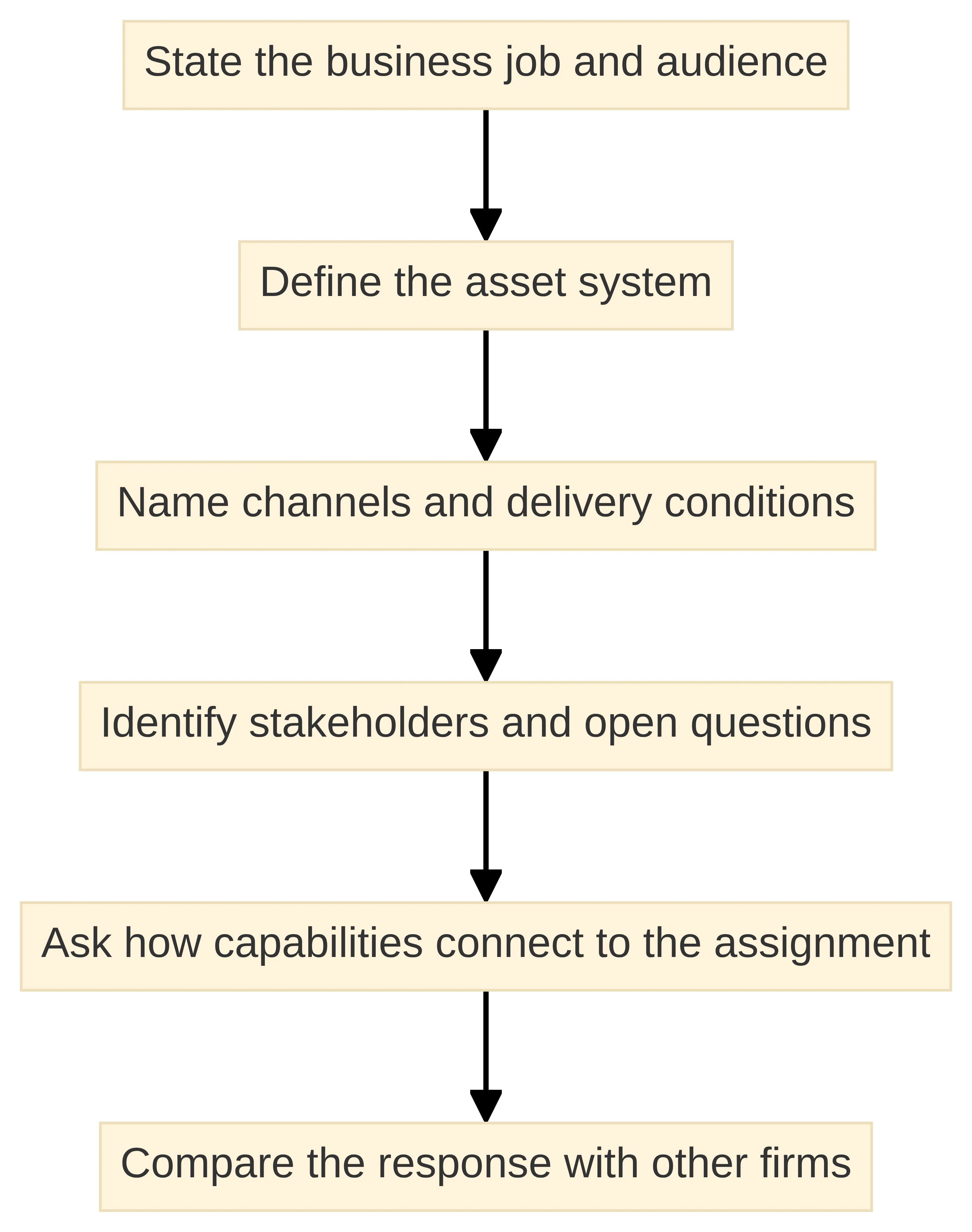
Apply the sequence in this order:
- State the business job and the audience.
- Define the asset system, including any photography, editing, animation, design, social, or UGC requirements.
- Name the channels, placements, versions, captions, and delivery conditions.
- Identify the stakeholders, approvals, timing, budget boundary, and open questions.
- Ask how we would connect our stated strategic and production capabilities to that assignment.
- Compare the response with the same record you use for other firms.
This keeps our work inside the same decision standard. The inquiry should test fit, not assume it.
A useful response should help you understand the proposed scope and the questions that need resolution. Keep those decisions open until the relevant project terms have been discussed.
Bring the comparison record into the conversation. Point to the objective, asset list, channel map, budget boundary, timing window, and unresolved questions you want addressed. That gives both sides a defined assignment to discuss and makes it easier for you to compare the response with other firms without changing the standard halfway through.
Send the brief as a request for consideration
The right provider decision begins with a defined job, a channel-aware asset plan, a realistic production scope, relevant proof, and a brief that makes open questions visible. If your assignment still has unresolved choices, include them clearly. A provider can assess a defined question more usefully than a broad request for “video marketing.”
If the fit remains plausible after you apply that sequence, keep the project type, deliverables, placement, timing, budget, audience, stakeholders, and notes together. It does not confirm a booked call, delivery, acceptance, availability, or result. Individual project suitability depends on the specific information and conditions discussed with a qualified professional.

 (201) 587-1400
 hello@overskies.com