Start with the decision a shortlist must support
Choosing a branding partner is not a contest between polished websites. Your shortlist must support a more useful decision: which candidate can understand the business problem, make sound brand decisions, turn those decisions into an identity and story, and carry the work into the channels where your customers meet the brand. That standard matters whether you lead a luxury brand, a retail business, or a DTC company serving customers in New Jersey, New York, or elsewhere in the United States.
Brand strategy and marketing strategy are related, but they answer different questions. A guide published on October 15, 2026, distinguished brand strategy as defining what a company is, while marketing strategy defines how it reaches and converts its audience through channels, messages, and offers. That distinction gives you a practical starting point: evaluate whether a candidate can define the brand before asking how the candidate will promote it.
A useful comparison should examine the same evidence from every candidate. Begin with categories that cover both the work and the working relationship:
- Experience and portfolio: Does the agency show relevant industries, comparable clients, and work that fits the brand's needs?
- Strategy and process: Can the team show how it develops brand strategy and connects it to the business?
- Creativity and innovation: Can it develop work that gives the brand a distinctive point of view?
- Identity and visual design: Can the visual system work beyond a presentation or logo file?
- Messaging and storytelling: Can strategy become clear messaging and a story that speaks to the intended audience?
- Collaboration and communication: How will the agency handle decisions, feedback, approvals, and handoffs?
For a marketing director, add three practical questions: Can the agency diagnose the business problem before designing? Can the work travel across relevant retail, ecommerce, social, paid media, packaging, and other contact points? How will you recognize progress and divide measurement responsibilities?
Do not assign a candidate a universal rank. Record what each candidate has demonstrated, what remains a claim, and what you still need to investigate. The result should be a shortlist that makes the next conversation more precise, not a winner selected by visibility alone.
Replace the ranking question with a proof question
The question who is the best agency sounds efficient, but it hides the conditions that make an agency suitable for your project. A luxury brand restoring distinction has a different problem from a DTC brand clarifying its position or a retailer trying to connect physical and digital experiences. You need evidence that matches your decision, not a label detached from the work you need done.
Replace the ranking question with this one: What can this candidate show that is relevant to our situation, and what does that evidence allow us to conclude?
A portfolio can show the quality and range of completed work. It can also help you examine whether a candidate has worked with comparable industries, clients, or brand problems. It does not, by itself, prove that the same team handled the work, that the candidate owned the strategy, or that the approach will fit your organization. Ask for the context behind each example.
For every project you review, ask:
- What problem existed before the engagement?
- What did the agency own, and what did the client or another partner own?
- Which research, strategic, identity, storytelling, or production decisions did the work include?
- Where did the work appear?
- What constraints shaped the result?
- What evidence shows that the work met the project’s stated objective?
Checking experience, comparable clients, and relevant examples is a recognized part of evaluating a branding agency. The practical improvement is to ask for the reasoning and scope behind the example instead of treating the finished image as the whole story.
Third-party profiles can add another kind of evidence, but they still require careful reading. An October 2026 Clutch profile described Starfish as specializing in brand strategy, corporate branding, and visual identity design. The profile also reported 100% positive feedback, 32 of 36 branding reviews at five stars, 49 projects, and an average project-cost range of $1,000,000–$9,999,999.
Those figures describe what that page reported about Starfish at that time. They do not establish that Starfish fits your scope, that the listed projects resemble your business, or that a review profile can replace a direct discussion about process and ownership. Treat third-party information as a lead for investigation, not as a universal verdict.
Create a short evidence record for every candidate with three headings: documented, illustrated, and unresolved. Put a published capability or verified project detail under documented. Put an attractive example whose scope is unclear under illustrated. Put every unanswered question under unresolved. This simple separation prevents a confident sales statement from receiving the same weight as a case study with a defined brief, deliverables, role, and result.
Define the evidence categories before comparing candidates
Write the comparison categories before you review another presentation. Otherwise, each candidate can define the terms in its own favor. The categories below give you a common vocabulary and a question to put to every provider.
-
Diagnosis: Ask what the candidate needs to learn before recommending a direction. Look for questions about customers, competitors, business priorities, existing perception, and the reason the project is happening now. Your evidence is the proposed discovery work and the decisions it is meant to inform.
-
Strategy: Ask what will be decided, not only what will be discussed. Look for a clear position, audience, promise, supporting reasons, and boundaries around what the brand will not try to be. Your evidence is the strategy output and the link between each decision and the business problem.
-
Identity: Ask whether the candidate develops an identity system or only a mark. Review the rules, components, examples, and ownership tools you would need to use the identity across your actual touchpoints. Your evidence is a system that can be applied consistently by the people responsible for daily brand work.
-
Storytelling: Ask how the strategy becomes a narrative, message architecture, or set of expressions that your audience can understand. Your evidence is the connection between the strategic choice and the words, images, or ideas used to communicate it.
-
Creative execution: Ask what the team will make, in which formats, through which production capabilities, and with what approval path. Your evidence is a defined deliverable set rather than a broad promise to create content.
-
Channel integration: Ask how the idea changes, if at all, across a store, product page, Amazon storefront, social channel, paid placement, email, package, or sales presentation. Your evidence is the candidate’s ability to show the work in the places where you need it to function.
-
Measurement: Ask what the work is expected to change, how you will observe that change, and which variables sit outside the agency’s control. Your evidence is a measurement plan with defined signals, not an implied guarantee.
-
Working fit: Ask who will lead the work, who makes decisions, how feedback is consolidated, how conflicts are handled, and what your team must supply. Your evidence is a working model you can recognize in the proposed engagement.
Keep the distinction between strategy and marketing visible throughout the comparison. Brand strategy defines the thing your marketing represents. Marketing strategy determines how you reach and convert people through channels, messages, and offers. A candidate may be strong in one and less suited to the other, so do not let a broad service description answer both questions for you.
Use the same prompt for every candidate: Show us the evidence, explain the role your team played, and state what conclusion we can reasonably draw from it. You can then compare substance without pretending that different engagements produced identical outputs.
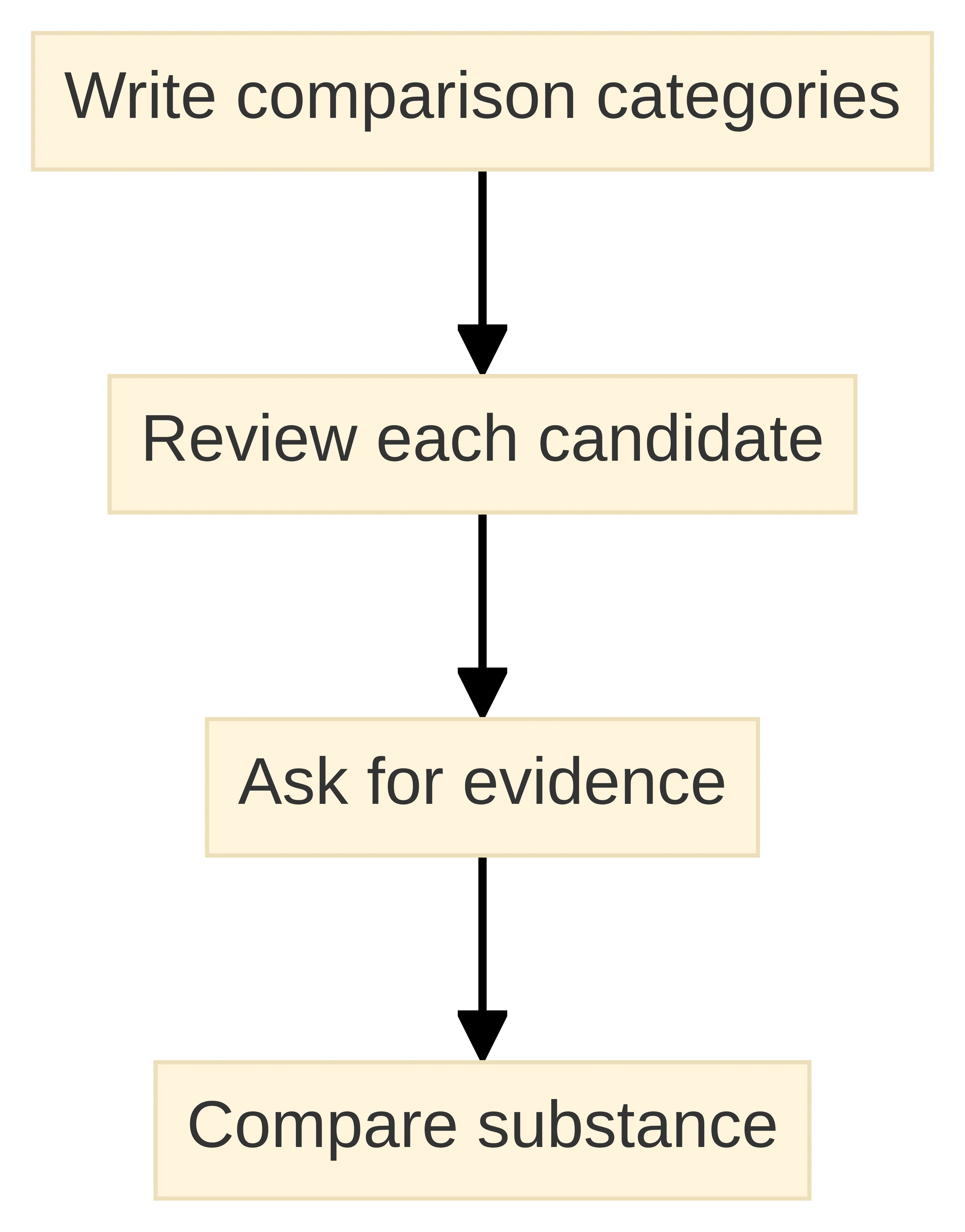
Test whether the agency can diagnose before it designs
A strong design response begins with a defined problem. Before you assess visual taste, test whether the candidate can diagnose what needs to change and what should remain. Ask how the team will investigate your current position, customer understanding, competitive set, internal assumptions, and commercial priorities.
For a New Jersey or New York brand, make the context specific to your market and channel mix. A retail business may need to reconcile store experience with ecommerce. A DTC brand may need a sharper reason to choose it when paid acquisition becomes less efficient. A luxury brand may need to protect distinction while making the proposition easier to understand. These are questions for your business, not assumptions the agency should make from a category label.
Ask each candidate to show the process it uses to develop brand strategy and connect that process to your business. A clear process is worth examining because it shows how the agency will turn inquiry into decisions you can inspect. Request a plain-language explanation of:
- What the team will learn first.
- Which people, materials, or market inputs it will consider.
- Which strategic choices it expects to make.
- How those choices will be tested with your internal stakeholders.
- What will be handed to the identity, storytelling, and execution teams.
A defined process matters when it produces decisions you can inspect. It does not tell you which process to buy. Your task is to see whether the candidate’s process is specific enough to guide your project.
Be cautious when a presentation moves straight from a vague ambition to a visual direction. A compelling design can still answer the wrong business question. Ask the candidate to name the diagnosis behind the direction and the evidence that would cause the team to change it. If the answer remains general, keep diagnosis unresolved rather than awarding strategy credit for presentation language.
Inspect the identity as a usable system
Brand identity should give your team a repeatable way to make decisions, not only a new logo to approve. A usable identity should be more than a mark: inspect whether its visual choices remain clear across the brand's actual touchpoints. Use that standard when you inspect the work.
Ask to see the identity in the forms your team will actually use. Depending on your scope, that may include a homepage, product detail page, retail sign, package, paid social unit, email, sales presentation, video title card, or marketplace storefront. The point is not to require every possible deliverable. The point is to see whether the identity’s choices remain legible when the format, audience, and amount of available space change.
Review five practical qualities:
- Recognition: Can you identify the consistent visual and verbal choices across examples?
- Application: Do the rules help a team decide what to do, rather than merely describe what looks good?
- Range: Can the system support a quiet luxury expression, a retail promotion, and a direct-response asset without losing its role?
- Ownership: Will your internal team receive the files, guidance, templates, and permissions needed for ordinary use?
- Governance: Is it clear who protects the identity when new products, campaigns, partners, or channels appear?
These are evaluation questions, not promises about what every identity project must contain. Match them to your actual scope and ask candidates to identify what they will deliver.
Run a touchpoint test before you compare visual preferences. Choose one high-value retail or ecommerce moment, one social or paid moment, and one internal or sales moment. Ask each candidate to show how the identity would guide all three. You are testing continuity and usability, not asking for speculative finished creative without a defined brief.
A candidate that can explain the decisions behind the system gives you more useful evidence than a candidate that presents a single polished application. Keep the question narrow: What part of this identity helps our team make the next correct application?
Follow the strategy into the story and the work
A brand story earns its place when it helps people understand why the brand matters and what the brand stands for. Ask how the candidate turns strategy into clear messaging and a story that speaks to the target audience. Then trace one strategic decision into one message, one narrative expression, and one piece of creative work.
Do not accept storytelling as a decorative layer added after the identity. Ask what the story makes easier for your marketing team: choosing an offer, writing a product page, briefing a photographer, directing a video, setting a retail message, or deciding which claims belong in a campaign.
Request a simple strategy-to-work trace for each candidate:
- Strategic choice: What position or promise is the work expressing?
- Audience meaning: What should your intended customer understand or feel?
- Message: What is the clearest language for that idea?
- Creative expression: How does the idea appear in design, photography, video, animation, or copy?
- Channel version: What changes when the idea moves to a product page, store, social platform, email, or paid placement?
- Approval point: Which decision must your team make before production continues?
This sequence keeps strategy, storytelling, and execution connected without treating them as one interchangeable service.
Then inspect the operating detail. Ask who writes, designs, directs, photographs, edits, animates, produces, and manages the channel work. Ask which capabilities sit inside the proposed team and which require another partner. Ask how feedback moves from your marketing director to the people doing the work.
For a commerce-driven brand, channel integration is not a claim you can judge from a brand film alone. Review the candidate’s ability to explain how the central idea will function in the places where a customer encounters it. A beautiful story that cannot guide product content, retail materials, or everyday social work remains an incomplete answer to your brief.
Keep the measurement question separate from the creative question. A campaign asset may be judged by a different signal from a repositioning effort or an identity rollout. Ask the candidate to define the intended business signal and the limits of its responsibility. That keeps a creative example from carrying an unsupported promise about commercial performance.
Separate agency-owned claims from project evidence
Every candidate will present a mixture of capability statements, examples, opinions, and results. Give those materials different evidentiary weight. A service page can tell you what the provider offers. A portfolio can show work attributed to the provider. A case study can add a brief, role, deliverables, and result. A third-party review can add an outside account of part of the experience. None of these categories should silently become another category.
Use four labels when you take notes:
- Capability: The provider describes a service or method.
- Artifact: You can inspect a piece of work and its stated scope.
- Project evidence: The provider connects the work to a defined problem, role, deliverable, timeframe, or result.
- Fit evidence: The provider shows how the work and operating model match your project conditions.
The last label deserves its own space. A candidate can have strong work and still be a poor fit for your decision structure, budget, timing, approvals, or channel requirements.
Starfish’s third-party profile illustrates why details need context. It described Starfish as specializing in brand strategy, corporate branding, and visual identity design, and reported reviews that cited strategic expertise, responsiveness, project management, delivery on time, and creative capabilities. It also reported 49 projects, 32 of 36 branding reviews at five stars, 100% positive feedback, and an average project-cost range of $1,000,000–$9,999,999.
Treat those figures as a snapshot of the profile as of October 26, 2026. You cannot use them to conclude that the listed project cost matches your budget, that the same team would work on your engagement, or that the review pattern answers your questions about storytelling, channel integration, or internal collaboration. Ask what the page does establish, then list the questions it leaves open.
Overskies describes its capabilities, and those statements should be read with the same discipline. We provide full-service branding and creative solutions. We use data and research to inform branding and digital marketing campaigns. We use research and creative expertise to uncover the right way to tell a brand story. Those statements establish the services and approach presented on our pages. They do not, without a project-specific conversation, establish your scope, timing, cost, suitability, or expected result.
For every claim that affects your decision, ask four questions: Who is making the claim? What exactly is being claimed? What project or artifact supports it? What conclusion is still outside the evidence? Keep the answers beside the claim. This protects your shortlist from inflated comparisons while still allowing a provider to make a clear case for its capabilities.
Assess Overskies against the same standard
Our documented approach includes using data and research to inform branding and digital marketing campaigns. We also describe combining creative agency thinking with data-derived customer understanding from a research agency. For your comparison, ask what that approach would mean in your project: which questions would be investigated, what inputs would be used, what decisions would result, and how those decisions would reach the creative team. The business facts establish the stated approach, while your project discussion must establish the specific work.
We help brands establish a unique position in the market with crafted brand identities. That capability maps to the identity category in your scorecard. Investigate them by asking to see the strategic decisions, identity applications, messaging work, and production outputs that would be relevant to your category and channels. A capability statement is the reason to ask a better question, not the reason to skip it.
We have experience working with brands that sell across complex channel mixes and need to maintain a unified brand story. We also partner with luxury and lifestyle brands. For a luxury, retail, or DTC marketing director, those statements make channel continuity and category relevance appropriate subjects for investigation. Ask us to connect the proposed work to your actual touchpoints, internal owners, approval process, and customer journey. Do not convert a general experience statement into a promise about your project.
Our Citizen case-study page reports that paid media combined with a refreshed storefront attracted 58% more visitors to Citizen’s Amazon store during the holiday season. This is a bounded case-study claim about that combination of work and that storefront. It is useful evidence to examine because it connects creative or channel work with a reported result. It is not a forecast for your brand, a general performance guarantee, or proof that every Overskies engagement follows the same model.
Use the same questions for Overskies that you use for every other candidate:
- What diagnosis would you conduct before recommending a direction?
- Which strategic decisions would you own?
- What identity and storytelling outputs would you deliver?
- Which production and channel capabilities would be included?
- What work would require another partner or your internal team?
- Which examples show comparable scope or audience?
- How would approvals, measurement, timing, and budget be handled?
That is the fair way to assess whether Overskies merits further consideration for your project. It keeps the comparison grounded in documented capability and project-specific fit rather than brand familiarity.
Request a comparable candidate dossier
Ask every shortlisted candidate for the same compact set of information. A comparable dossier reduces the advantage of the provider with the most polished presentation and gives your team material it can review side by side. The request should reflect the evaluation criteria of experience, strategy, identity, storytelling, creativity, collaboration, and communication.
Request these items in a consistent order:
- Relevant work: Three examples that resemble your category, audience, channel mix, or business problem. Require a short description of the brief, the candidate’s role, the deliverables, and the work’s current status.
- Diagnosis and strategy: The process the team would use, the decisions it expects to make, and the inputs it would need from you.
- Identity evidence: A system example showing how the work operates across more than one touchpoint, with the usable guidance or files that supported application.
- Story and messaging: An example tracing a strategic choice into audience-facing language and creative expression.
- Execution model: The people and capabilities assigned to strategy, design, writing, production, account leadership, and channel work.
- Project evidence: Any documented result with its timeframe, scope, measurement definition, and the candidate’s role. If no result can be shared, ask the candidate to state that boundary clearly.
- Working model: Decision owners, feedback cycles, approvals, meetings, dependencies, and the materials your team must provide.
- Commercial outline: Proposed scope, timing assumptions, cost structure, and items that would change the proposal.
Ask candidates to identify what they did not own. An agency may have designed an identity without running the campaign, produced a campaign without setting the strategy, or contributed to a case study alongside other partners. Clear ownership makes the comparison more honest and helps you avoid giving one provider credit for work outside its role.
Review the dossiers in two passes. First, mark evidence that directly matches your project. Second, mark attractive material that needs clarification. Do not average those categories together. Your shortlist should contain candidates whose unresolved questions are answerable within a next conversation, not candidates whose missing information is hidden by a strong visual impression.
Gather the internal brief before asking for proposals
Your comparison will remain vague if your own team has not defined the decision. Before you ask for proposals, gather the information a candidate needs to respond to the same problem. This does not require a finished strategy. It requires enough shared context to make the proposed work comparable.
Write down:
- The business situation that prompted the project now.
- The product, service, market, or portfolio in scope.
- The audience you need to understand, reach, or retain.
- The position customers currently associate with the brand and the position you want to investigate.
- The markets and regions involved, including any New Jersey or New York considerations that affect retail, sales, distribution, or customer experience.
- The channels and touchpoints that matter most, such as stores, ecommerce, marketplaces, social platforms, paid media, packaging, email, or sales materials.
- Existing research, customer intelligence, brand guidelines, performance information, and creative assets.
- Internal stakeholders, decision rights, approval constraints, and the people who will use the eventual system.
- The deliverables you already know you need and the decisions that remain open.
- Your working timing, budget range, and measures of progress.
Separate requirements from preferences. A requirement might be a retail launch date, a marketplace asset set, a brand architecture decision, or a need for internal teams to apply the identity. A preference might be a particular style, production format, meeting rhythm, or presentation approach. Candidates can then respond to the conditions that affect the work instead of trying to guess what will impress your team.
Prepare questions your internal team can answer consistently:
- What must be different after this work?
- What must remain recognizable?
- Which decision will be hardest to make internally?
- Where does the current story break across channels?
- Which audience or customer moment deserves priority?
- What evidence would make you change direction?
- What would make the engagement difficult to operate?
If your team cannot answer these questions yet, mark them as discovery topics rather than disguising uncertainty as a completed brief. A candidate can help resolve them, but the proposal should show where that discovery sits in the work.
Give every candidate the same core information and ask each to return the same categories of response. Then compare how each provider interprets the problem, what it leaves open, and how its proposed work connects diagnosis to strategy, identity, story, execution, and channel use. The quality of your shortlist depends partly on the quality of the question you put in front of it.
Choose the next investigation, not the loudest winner
The useful outcome of this comparison is not a universal winner. It is a defensible next investigation. Shortlist the candidates that can show relevant work, explain their diagnosis and strategy, connect identity to storytelling and execution, describe channel application, separate documented results from promotional language, and operate within the way your team makes decisions.
Overskies belongs in that comparison when its documented branding, research, storytelling, identity, creative, and channel capabilities match the questions your project needs answered. The same standard applies to every other candidate. Gather the internal context, request comparable evidence, record the unresolved points, and use the next conversation to test fit rather than reward confidence.
Your marketing team makes the final suitability decision from the project’s requirements, available evidence, and working conditions. A clear submission gives any candidate a fair opportunity to respond to the actual problem instead of a vague request for ideas.
What should you verify before requesting a branding project brief?
What criteria should I use to evaluate a branding agency?
Consider factors such as the agency's experience and portfolio, their defined brand strategy process, creativity and innovation, ability to create a memorable brand identity, storytelling capabilities, and their collaboration and communication style throughout the project.
How can I assess an agency's storytelling capabilities?
Ask the agency to demonstrate how their brand strategy translates into clear messaging and narratives that resonate with the target audience.
What should I look for in a branding agency's portfolio?
Review the agency's portfolio for relevant work that aligns with your industry and brand needs. Check for examples that showcase their ability to address similar business challenges and resonate with your target audience.
How can I ensure that the branding agency understands my business needs?
Engage the agency in discussions about your specific business challenges and goals. Ask them to outline their process for diagnosing your brand's current position and how they plan to develop a strategy that aligns with your objectives.
What information should I gather before requesting a project brief from a branding agency?
Prepare details about your business situation, target audience, desired brand positioning, relevant channels, existing research, and any internal constraints. This context will help the agency tailor their proposal to your specific needs.
How can I compare different branding agencies effectively?
Create a scorecard that evaluates each agency based on consistent criteria such as their strategic approach, identity development, storytelling, creative execution, and ability to integrate across channels. This will help you make informed comparisons.

 (201) 587-1400
 hello@overskies.com