Start with a New York City scope check
Before comparing New York City branding agencies, decide what must be true for this assignment. New York City identifies the market you are evaluating; it does not, by itself, describe an agency’s strategic scope or the work your team will receive. For a luxury, retail, or DTC brand in New Jersey, start with a geography-and-scope check: note how each candidate describes its NYC work, what it says it will own, and which responsibilities would remain with your team or another partner.
That check keeps a branding label from doing too much work. Read the candidate’s description for the boundary between diagnosis and brand decisions on one side, and the assets or channel activity that follow on the other. The first useful artifact is a scope map. Put the assignment’s required decisions and deliverables in one column, the candidate’s documented commitments in another, and the unanswered questions beside them. This makes gaps visible before a shortlist becomes a sales conversation, while leaving room to assess the candidate’s actual work and commercial fit later.
Use this sequence to make the decision more concrete:
- Define the business and brand problem before reviewing agencies.
- Separate strategy, identity, channel execution, and adjacent production services.
- Ask how each candidate moves from diagnosis to decisions and deliverables.
- Test whether the proposed team and working model fit your internal capacity.
- Compare relevant work, responsibilities, timing, and budget assumptions in the same format.
- Record what remains unclear before you move a candidate into a proposal or project-brief conversation.
The result should be a smaller group of agencies that merit further investigation, not an unsupported ranking. Your goal is not to announce a winner from public information. Your goal is to identify which conversations are worth having next.
Define the work before comparing providers
A branding assignment can cover more than visual identity. One useful distinction is whether an agency covers a full brand-development scope that may include strategy, visual identity, verbal identity, guidelines, and activation, or whether it offers only one part of that work.
Write down which of those parts your team needs before you compare providers. If you need a positioning decision and a usable identity system, a design-only engagement may leave a strategic gap. If your strategy already exists and the immediate need is production, paying for a full repositioning process may create a different mismatch. The right scope depends on the work your team must complete, not on how broadly a provider describes its category.
Brand strategy and identity work also need to be separated from adjacent services. A provider may discuss market research, guidelines, social-media branding, rebranding, website work, or cross-channel marketing assets under a broad branding label. Those services can connect, but they do not answer the same question.
Use a short scope statement with five parts:
- The decision: what must change, become clearer, or become more usable?
- The audience: which customer groups, buyers, or stakeholders matter to the assignment?
- The deliverables: which strategy documents, identity components, guidelines, campaigns, or assets must be delivered?
- The channels: where must the brand work appear after the engagement?
- The commercial frame: what timing, internal resources, approval steps, and budget assumptions must the provider address?
A brand brief helps an external team understand your business needs, especially when marketing, advertising, and design responsibilities sit with different groups. Keep the brief specific enough that every candidate is responding to the same work.
Do not let a broad service list substitute for a defined assignment. Ask each agency to mark what it owns, what it recommends, what it produces, and what your team or another partner must handle. That distinction will make later proposals easier to compare.
Separate the scope into three layers:
- Brand decisions: positioning, audience, promise, messaging, verbal identity, and the role the brand should occupy.
- Brand system: logo, typography, color, imagery, tone, guidelines, templates, and rules for use.
- Market execution: campaigns, social content, website applications, retail materials, e-commerce assets, photography, video, or experiential work.
A provider may cover all three layers, two of them, or only a defined piece. Record the boundary before you interpret a portfolio or compare a fee.
Test strategic capability at the point of diagnosis
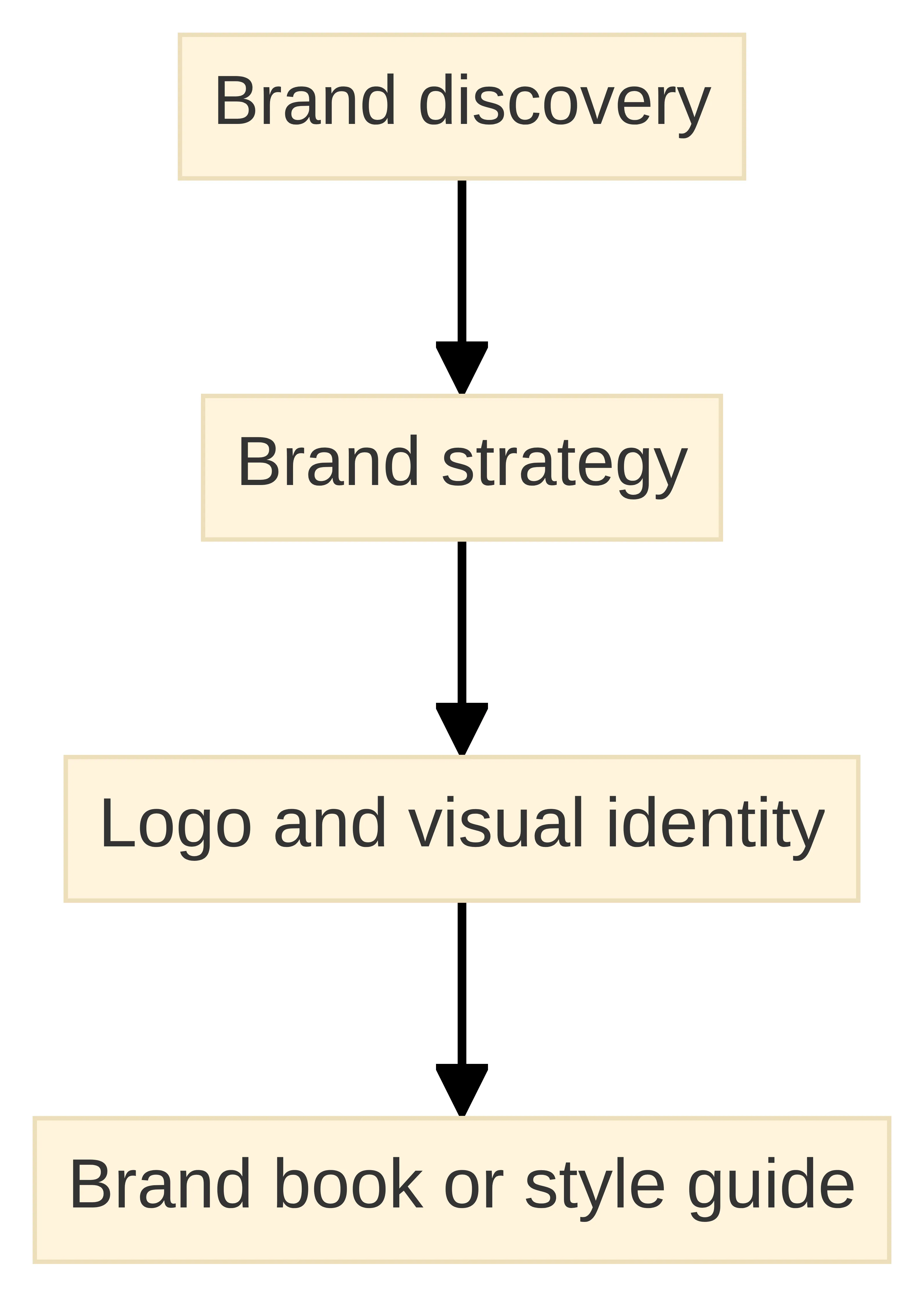
Treat that sequence as a question to ask, not as a universal agency template.
The useful test is whether the first stage produces decisions that the later work can use. One NYC-serving process describes discovery as the point where the target audience and project goals are defined. Its strategy stage then addresses channels, messaging, growth opportunities, and key performance indicators. That gives you a practical standard for examining any candidate: ask what the team will learn, what it will decide, and how those decisions will direct the work that follows.
Ask each shortlisted agency to explain:
- What will you learn or decide during discovery?
- How will the team distinguish audience information from assumptions?
- Which business and brand goals will shape the strategy?
- How will the strategy affect messaging, channel choices, and priorities?
- Which performance indicators belong in the assignment, and which fall outside it?
- What changes if the diagnosis shows that the original brief is incomplete?
- Which findings will become deliverables, and which will remain internal working material?
Listen for a chain of reasoning, not a sequence of workshop names. You should be able to see how the agency will move from the problem you bring to the decisions it proposes. If the assignment comes from a New Jersey retailer or DTC brand with both physical and digital selling environments, ask how those contexts will be considered together rather than treated as unrelated channels.
A strong strategic response does not need to promise a particular result. It does need to make the work legible: the questions, decisions, owners, and outputs should connect. If a candidate moves directly from a vague challenge to visual concepts, ask for the diagnostic step before comparing creative work.
Also ask what happens when the diagnosis changes the brief. A mature working plan should show where new information affects priorities, deliverables, timing, or budget. You do not need a rigid process. You do need a visible relationship between the problem, the strategic choice, and the work you will receive.
Inspect identity depth, not just visual polish
A visual identity is one part of a brand system. Review whether the proposed work addresses the elements your assignment requires, such as positioning, verbal identity, logo use, typography, color, imagery, tone of voice, and guidelines for applying those elements.
The point is not to reward the most polished presentation. It is to determine whether your team can use the resulting system when the work leaves the pitch deck. Ask to see how the identity is organized, what decisions are fixed, what choices remain flexible, and how the rules apply beyond the primary presentation format.
Use the same inspection questions for every candidate:
- What strategic decision does each identity element express?
- Which verbal and visual choices are documented?
- Are the guidelines written for the people who will use them day to day?
- What examples show the system in more than one context?
- Which deliverables are finished assets, and which are recommendations?
- Who will adapt or maintain the system after launch?
- What is included for internal teams, production partners, retailers, or channel owners?
A brand book or style guide is not the same as a complete identity engagement. Confirm whether the proposed package includes the identity decisions, the guidance, and the applications your team expects. Ask whether the provider is delivering a working system or only documenting a set of visual choices after the fact.
For a luxury brand, you may need to examine restraint, detail, and the handling of premium cues. For a retail or DTC brand, you may need to examine how the identity behaves across the customer-facing places named in your brief. Those are evaluation prompts, not reasons to assume that any agency can solve them.
Request an example that shows the identity in the type of environment your team manages: a product detail page, retail signage, packaging direction, social template, campaign asset, or sales presentation. Then ask which parts came from the identity system and which were created for that individual execution. That distinction helps you judge whether the system can support repeated use.
Follow the brand into actual channels
Channel execution is where a brand strategy becomes observable. Branding agencies may associate their work with social-media branding, cross-channel marketing assets, website design, rebranding, and other downstream applications. Treat each category as a separate capability to examine rather than assuming that a strategy automatically becomes usable content.
Start with the channels named in your assignment. If the work must reach social platforms, ask to see how the identity governs profiles, templates, posts, reels, or campaigns. If the work must support a website, retail environment, e-commerce experience, or campaign, ask how the same strategic decisions are translated there. Use your own channel list instead of accepting a generic presentation.
Ask for a channel translation map with four columns:
- Brand decision: the positioning, message, visual rule, or behavior that must carry through.
- Channel expression: how that decision appears in the relevant customer-facing context.
- Required asset: what the agency will create, adapt, or document.
- Owner and approval: who makes the decision and who signs off.
This map helps you distinguish a partner that can connect strategy with execution from a provider that stops at a concept or identity presentation. It also exposes hidden production work before that work becomes a timing or budget surprise. For a retail or e-commerce team serving customers in New Jersey and New York, the same exercise can show where physical and digital applications share rules and where they need separate treatment.
Request one or two examples that resemble the assignment in channel mix, audience, and scale. Then ask the candidate to explain the strategic choice behind each application. If the agency cannot connect the example to a decision, keep its channel capability unconfirmed.
Ask for the handoff details as well. Find out whether the provider supplies editable templates, production guidance, channel specifications, asset libraries, or only finished examples. Your team should know what it can operate after the engagement and what would require another request to the agency.
Match the agency’s operating model to the team
An agency’s operating model matters as much as its creative scope. A marketing team, advertising agency, and design agency may carry different responsibilities, and a brand brief can help the external team understand the business need. Your job is to identify where strategy, creative development, production, approvals, and implementation sit in the proposed relationship.
Ask for the working model in plain terms:
- Who leads the engagement day to day?
- Who makes the strategic decisions?
- Which specialists join for identity, content, social, or experiential work?
- What does your internal team need to provide?
- How many approval stages are assumed?
- Which partner handles work outside the agency’s scope?
- Who resolves a disagreement between brand, creative, channel, and commercial stakeholders?
Do not treat a senior presentation as proof that senior people will manage the assignment. Request the proposed team, responsibilities, availability assumptions, and escalation path in writing.
Commercial fit is part of operating fit. Ask every candidate to state the assumptions behind its timing and budget: the number of deliverables, rounds of revision, research or discovery work, production requirements, travel or location needs, channel adaptations, and post-launch support. You do not need identical prices to compare providers, but you do need comparable scope.
A lower figure may reflect fewer decisions, fewer applications, less senior involvement, or a different delivery boundary. A higher figure may include work your assignment does not require. Compare the assumptions before comparing the totals.
Make the commercial conversation specific enough to expose change points. Ask what happens if the number of markets, products, stakeholders, deliverables, or revision rounds changes. Ask which expenses sit outside the estimate. Ask who owns production coordination when the work moves from identity into photography, video, social, retail, or e-commerce execution.
Choose the operating model that matches your team’s real capacity. If your marketing group needs a partner to carry strategy through execution, make that responsibility explicit. If your team already owns strategy or production, remove those items from the comparison instead of paying for overlap.
For a growth-stage or enterprise brand, test the model against the people who will actually approve and use the work. A plan that sounds efficient in a presentation may become slow if every channel owner, regional stakeholder, or legal reviewer enters late. Put those approval conditions into the brief before asking agencies to commit to timing.
Treat portfolio visibility as a starting signal
A recognizable NYC portfolio is a lead, not proof of fit. Work for prominent brands can show that an agency has produced visible work, but it does not establish that the work is comparable in industry, scale, or budget parameters.
Before you treat a portfolio as relevant, ask the agency to identify the assignment behind each example. You need enough context to compare the client situation with your own rather than judging presentation quality in isolation. A luxury product launch, a retail rebrand, and a DTC growth assignment may all use polished imagery while requiring different strategic decisions and operating models.
Test each example against four questions:
- Was the work comparable in scale to your engagement?
- Did the industry or customer context resemble yours?
- Were the budget parameters comparable?
- Did the agency deliver the kind of identity, strategy, or channel work you need?
Add two questions for a more useful portfolio conversation:
- What part of the work did the agency own, and what came from the client or another partner?
- Which deliverables can you inspect rather than only seeing the finished campaign image?
A candidate that cannot answer these questions may still deserve investigation, but the portfolio should remain a signal rather than a conclusion. Keep the burden of comparison on the assignment you need completed.
Do not infer a working relationship from a client logo. Ask how decisions were made, who participated, what changed during the engagement, and how the work was handed off. If the agency cannot share details because of confidentiality, ask for an anonymized explanation of scope, team structure, and deliverables.
The same boundary applies to awards, press coverage, and polished case-study language. These materials may help you find questions. They do not answer whether the agency can work within your organization, budget assumptions, approval structure, and channel requirements.
Build a New York City scope record before sending a brand brief
Start with the New York City scope question. For each provider, identify whether its documented offer covers the brand-development work your assignment requires, where adjacent services begin, and which channel, team, timing, and budget conditions still need clarification.
Request these items:
- Relevant work: two or three examples matched to your industry, audience, scale, and assignment type.
- Process detail: the stages from discovery and diagnosis through strategy, identity, applications, and handoff.
- Deliverables: a precise list of documents, identity components, channel assets, production outputs, and guidance.
- Team responsibilities: names or roles, senior involvement, partner responsibilities, and your internal commitments.
- References: contacts or conversations that can address collaboration, decision-making, and delivery conditions.
- Timing assumptions: milestones, review windows, dependencies, and what could change the schedule.
- Budget assumptions: what is included, what is excluded, and which variables could change the estimate.
Use the same request for each candidate. A different presentation format should not prevent you from comparing the underlying work.
Create a simple comparison record with one row per candidate and one column for each requirement. Mark every item as demonstrated, described, unclear, or outside scope. This is a working aid, not a quality score. Its immediate use is to show where you need a follow-up question before advancing an agency.
Include columns for:
- Assignment understanding
- Strategic diagnosis
- Identity scope
- Verbal and visual system
- Channel applications
- Relevant examples
- Proposed team
- Client responsibilities
- Timing conditions
- Budget assumptions
- Open questions
Keep unanswered items visible. Do not convert a polished case study, an impressive client name, or a confident promise into proof of a capability that the assignment still requires you to test.
Comparable examples should address scale, industry relevance, and budget fit before you treat an agency’s NYC reputation as predictive of capability. Ask for those comparisons directly, then keep the response beside the original requirement so the next discussion stays concrete.
If a candidate provides an incomplete pack, record the missing item rather than filling the gap with an assumption. A follow-up request can be useful evidence about how clearly the agency communicates, but it should not be treated as proof of creative or strategic quality by itself.
Keep claims and proof in separate columns
A claim is a starting point for investigation. Proof is the material that lets you judge whether the claim applies to your assignment. Keep those categories separate so a service description does not quietly become a conclusion about fit.
This distinction is especially useful when several New York providers use similar language. “Strategy,” “full service,” “integrated,” and “scalable” can describe very different scopes. Translate each phrase into a question about decisions, deliverables, responsibilities, conditions, and examples.
| Provider claim to examine | Proof to request | Boundary to keep visible |
|---|---|---|
| “We provide brand strategy.” | The diagnostic questions, strategic decisions, outputs, and team member responsible. | A strategy label does not show how the work will address your assignment. |
| “We create complete identities.” | The identity components, verbal work, guidelines, applications, and handoff materials included. | A logo presentation is not automatically a complete identity system. |
| “We support every channel.” | Examples and deliverables for the channels named in your brief, with owners and approval steps. | A broad channel list does not establish depth in your required channels. |
| “We work with major brands.” | Comparable work at similar scale, in a similar industry, with similar budget conditions. | Visibility does not establish fit. |
| “We can deliver within your timing.” | Milestones, dependencies, review windows, staffing, and assumptions behind the schedule. | A date without conditions is not a delivery plan. |
| “We fit your budget.” | Scope, exclusions, revision limits, production assumptions, and payment terms. | A total without scope is not a comparable commercial proposal. |
Use the table during every agency conversation. When a claim is clear but its proof is missing, record a follow-up request. When the proof is supplied but does not match your assignment, record the boundary instead of stretching the interpretation.
Do the same with your own brief. If you ask for “a refreshed brand,” define what refreshed means in decisions and deliverables. If you ask for “content at scale,” specify the channels, asset types, approvals, production inputs, and operating conditions that scale requires. Clear buyer language makes agency responses more comparable.
Include Overskies only with the geography stated plainly
Overskies is based in New Jersey, not New York City. Include Overskies in your comparison only if a New Jersey partner fits the geography, collaboration pattern, and delivery requirements of your assignment. A New Jersey location may work for a New York-area commerce brand, but that is a condition for you to assess, not a reason to treat the provider as a New York City agency.
We provide full-service branding and creative solutions. We help brands articulate their story and mission to engage consumers and build lasting relationships. We use data and research to inform branding and digital marketing campaigns. We also provide strategic video production.
Apply the same questions to Overskies that you apply to NYC agencies:
- Which parts of your assignment would Overskies own?
- What strategy, identity, channel, and production deliverables would be included?
- How would the team work with your internal stakeholders and other partners?
- Which relevant examples, timing assumptions, and budget conditions would you need to review?
- Does a New Jersey location work for your meetings, approvals, production, and launch requirements?
- Which parts of the work would remain with your team or another partner?
Geography is a fit condition, not a quality judgment. State it plainly, then compare the documented scope against the assignment. Do not give Overskies a different standard because it appears on your shortlist.
We take a collaborative, human-focused approach to digital marketing. Treat that as a description of how we say we work, then ask the same practical questions about responsibilities, deliverables, timing, and budget that you ask of every other provider.
If your assignment includes video or broader channel execution, we also provide strategic video production. Ask how that capability would connect to the brand decisions in your brief, what outputs it covers, and which production conditions would affect the proposed scope.
Use the brief as the final fit test
Your shortlist is ready for a next conversation when every candidate has responded to the same assignment: the business problem, audience, strategic decisions, identity needs, channels, deliverables, team responsibilities, timing, and budget assumptions. The strongest-looking name should not advance unless its documented response fits those conditions.
Use the comparison record to choose the next investigation, not to manufacture a ranking. Advance the candidates whose open questions are answerable and whose documented scope matches the work you need. If geography, ownership, timing, or budget remains incompatible, remove the candidate before asking for a more detailed proposal.
If Overskies fits your geography and the scope you need, a submitted project brief gives our team a defined assignment to review. Submission is not a booked call or delivery confirmation. Your organization should make its final suitability and contracting decisions after reviewing the documented scope, responsibilities, timing, and budget conditions.
What should you verify before sending a branding project brief?
What should I consider when evaluating branding agencies in New York City?
Focus on the specific assignment your team needs to complete, separating strategy, identity, and execution from adjacent services. Define the business problem, audience, deliverables, channels, and commercial conditions before comparing agencies.
How can I differentiate between branding strategy and identity work?
Branding strategy involves defining the brand's core identity and positioning, while identity work focuses on visual elements like logos, typography, and guidelines. Ensure you clarify which components your project requires.
What evidence should I request from a branding agency?
Ask for relevant work examples, detailed processes from discovery to execution, a list of deliverables, team responsibilities, references, and timing and budget assumptions to assess their fit for your needs.
How can I ensure that a branding agency's portfolio is relevant to my project?
Request context for each portfolio example, including the assignment behind the work, scale, industry relevance, and budget parameters to determine if their experience aligns with your requirements.
What is the importance of a brand brief when working with an agency?
A brand brief helps external teams understand your business needs and ensures that all candidates respond to the same assignment, making it easier to compare their proposals.
How does Overskies differentiate itself from New York City agencies?
Overskies is based in New Jersey and focuses on providing full-service branding and creative solutions, emphasizing a collaborative approach and experience with brands that operate across complex channel mixes.
What steps should I take before sending a project brief to an agency?
Ensure that you have clearly defined your assignment, including the business problem, audience, deliverables, and budget assumptions. This clarity will help the agency understand your needs and respond effectively.

 (201) 587-1400
 hello@overskies.com